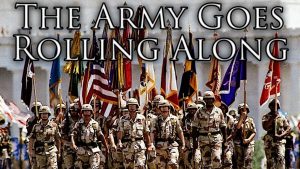
I grew up on various airbases, and we kids learned all of the anthems of the various arms of the military at an early age. “The caissons go rolling along” was the Army song, “Anchors away belonged to the Navy, “From the Halls of Montezuma” meant the Marines, and “Off we go into the wild blue yonder” was ours, being the Airforce brats we were.
This was all almost 60 years ago, and the Army no longer uses caissons – two-wheeled wagons that carried artillery ammunition and was attached to a cannon. Modern armies (including the United States Army) no longer use caissons for their original battlefield role. Mechanized vehicles and advanced logistics systems have completely replaced them. Just about the only place they still crop up is at military funerals, where they carry the casket.
I was curious, so I asked ChatGTP, “How many people today know what a caisson is?” The answer was fascinating.
It turns out that linguists use so-called vocabulary familiarity ladders to ascertain how many fifth-graders understand a given word. The one ChatGPT uses has six tiers, from “Nearly universal (everyone knows)” like bridge, road or soldier to “expert-level jargon”, word like hydro demolition, soil nailing, and diaphragm wall which only professionals will recognize.
“Caissons sit in the middle on tier 4 (“obscure but not rare”), along with words like abutment and revetment. I had to look this last one up, which is a facing or retaining wall made of materials like stone, concrete, or wood used to protect embankments, riverbanks, or shorelines from erosion and wave impact.
But there is a difference between simply recognizing a word and being able to give an exact definition. For “caisson”, it turn out than between 20 and 40 percent of Americans recognize it, but only between 5 and 15 percent can tell you what the hell it means.
For an important patriotic song, that’s pretty low. It means that on Fourth of July parades most people just belt it out without understanding what they are singing. I find that kind of disappointing.
I can’t help wondering whether our Commander in Chief, the orange-haired gargoyle (a word that ranks on tier 3 on the language ladder, one notch above caisson), knows what he is singing about. After all, he is the official Commander in Chief of the Army.
Maybe somebody ought to come up with new words for the song, word more fitted to the meanest understanding, namley Trump’s.
Which brings me back to the original song, which is performed at the end of every official US Army ceremony. Soldiers are expected to rise and sing along, which means Trump, too. It turns out somebody else already had the idea of simplifying the lyrics. In 1917, John Philip Sousa (he of the sousaphone) had written an alternate set of lyrics for the Caison Song entitled „U.S. Field Artillery March“, which substitues the caisson line for „And the Army keeps marching along.“
That should be just about right for our glorious Warrior in Chief.


 Lots of videos on my YouTube Channel
 Meine Smartphonekamera macht sich manchmal beim Knipsen selbständig, und oft kommen dabei wirklich gute Bilder heraus, ohne dass ich etwas dafür kann.