
Guest article by Justas Pukys of Surfshark*
Browsers collect more information about you than you may realize. The three browsers with the highest privacy risk are Yandex, Microsoft Edge, and Google Chrome. Globally, seven in ten internet users rely on the Google Chrome browser, according to research by Surfshark, a cybersecurity company headquartered in the Netherlands.
Why do browsers collect excessive amounts of information?
If Instacart’s “different price tests“, where buyers were charged different prices for the same food products, seemingly based on user profiles, concern you, you might find it interesting to know why companies collect and use your data.
For example, the study shows that some mobile browsers collect excessive amounts of information. The Play Store’s privacy policies indicate that Yandex collects 25 out of a possible 38 user data types, while Microsoft Edge collects 20 and Google Chrome collects 19.
Among the vast amounts of users’ information, such as financial data, photos, videos, and web browsing history, Yandex and Google Chrome also collect location data. Microsoft Edge and Yandex collect users’ contacts, files, and documents. Notably, Yandex is the only browser among all those analyzed that collects in-app messages.
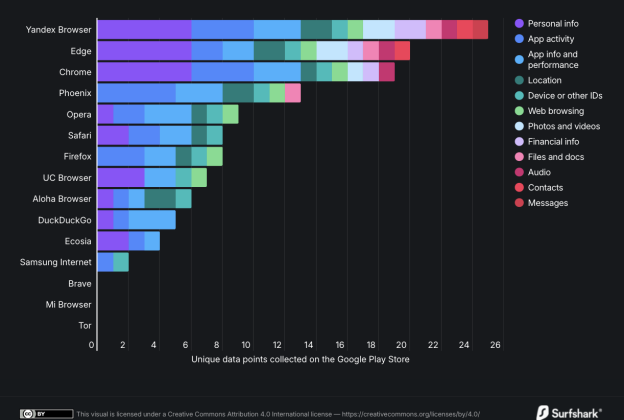
The developers of the three most data-hungry mobile browsers indicate they collect data such as users’ contacts, files, documents, or web browsing history for app functionality, analytics, personalization, account management, and fraud prevention, security, and compliance purposes. The latter purpose is listed as the reason Yandex collects users‘ in-app messages.
Digging deeper into what users’ data mobile browsers share with third parties, it appears that Yandex shares user payment info. Microsoft Edge shares approximate and precise location as well as user IDs (identifiers that relate to an identifiable person). Aloha shares crash logs, approximate location, and precise location. Meanwhile, Phoenix shares app crash logs, diagnostics, other app performance data, app interactions, and device or other IDs.
The more data a browser collects, the less private your online life becomes. When you consent to share your data, you lose control over how it’s used. As we can see, browsers not only collect but also share users’ data with third parties. Browsing habits and interests can reveal highly sensitive details, such as health concerns, financial status, political views, or personal struggles, information that people usually don’t feel comfortable sharing publicly.
Knowing that only two out of ten people consider themselves ‘privacy policy-conscious’ means that browser companies gather large volumes of users’ personal information.
In the meantime, the study shows that among the privacy-friendliest browsers is Ecosia, which collects four data types. Samsung Internet Browser collects only two data types, while Brave, Mi Browser, and Tor don’t collect any users’ data at all.
Three browsers account for 94% of the global mobile browser market share. Chrome leads with 68.5%, followed by Safari at 22% and Samsung Internet at 3.5%.
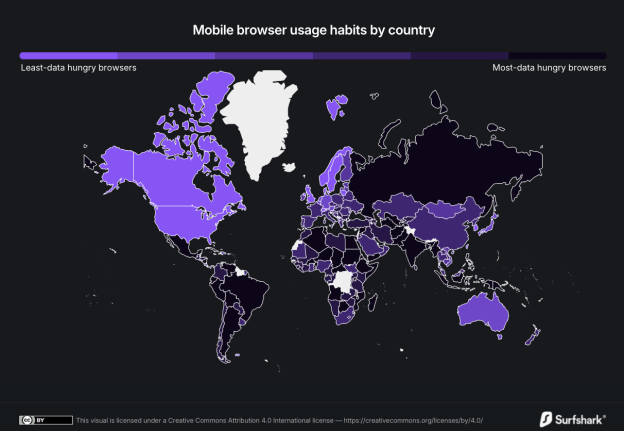
Surfshark analysed which countries have the lowest and highest privacy risks, depending on the browsers their populations use, and created a map reflecting these tendencies. The more the country’s population tends to use data-hungry browsers, the higher the privacy risk score.
The results show that people in Russia, Hungary, Bulgaria, Serbia, Mexico, the Philippines, India, Brazil, Venezuela, Ethiopia, and some other countries use the most data-hungry and privacy-risky browsers.
Meanwhile, people in Norway, South Korea, Sweden, Switzerland, Denmark, Canada, the US, and Taiwan use, on average, the most privacy-friendly browsers.
Collected users’ data allows companies to create a digital profile of you, predict your behavior, and make decisions based on it, for example, showing you different prices, ads, or offers. If a company suffers a breach or mishandles data, there’s a high chance your information could be leaked or exposed. Findings show that personal data that can identify individual customers was the most commonly compromised type of information in data breaches in 2025.
We strongly advise starting to use a privacy-friendly browser. Otherwise, share as little personal data as possible, providing only the minimum information your mobile browser needs to function. Also, don’t forget to review browser app permissions regularly and use a password manager to keep your account passwords secure.
Using a VPN while browsing adds an extra layer of protection by encrypting internet traffic and hiding IP addresses, especially on public networks. In cases of data breaches, I advise using specific tools to monitor whether your personal information has been exposed and to react accordingly.
* Justas Pukys is a certified IT systems manager at Surfshark.


 Lots of videos on my YouTube Channel
 Meine Smartphonekamera macht sich manchmal beim Knipsen selbständig, und oft kommen dabei wirklich gute Bilder heraus, ohne dass ich etwas dafür kann.