My Munich

I’m lovin‘ it still!

My Munich

I recently organized a trip to Munich for our Lions Club and I entitled it “My Munich”. Here’s the agenda:

1st evening: Dinner at “Paros” in Heidhausen (Kirchenstrasse). Why go to a Greek restaurant if you’re in Munich? Because it is simply the best one I’ve seen outside of Greece. It’s always full, always loud, and the lamb is unbelievable!

Next morning: Eat Weisswurst (traditional Bavarian sausage made from minced veal and pork back bacon flavoured with parsley, lemon, mace, onions, ginger, and cardamom) and drink Weissbeer at Franziskaner across the street from Nationaltheater. Spread lots of sweet mustard on them!

Afterwards: Walk up past Marienplatz to the Viktualienmarkt, the big open-air market where you can get almost anything that’s edible. Stroll around and sniff the scents, savor the sights. Weiterlesen

Veröffentlicht unter Allgemein | Verschlagwortet mit , , , , , , , | Hinterlasse einen Kommentar

IoT spending to reach 732 billion by 2026

Global IoT device revenue in the residential and commercial sectors is expected to total more than $732 billion from 2016 to 2026, according to a new report by Navigant Research, a market research and consulting firm based in Colder, Colorado. As owners and operators look to take advantage of technologies that can enhance energy management, provide greater control, and increase comfort, awareness of these devices ability to enable greater efficiencies will increase, the report’s authors speculate.

The report, IoT Devices for Energy Management, provides market forecasts segmented by device, sector, and region, and highlighting the expected trends and potential market size through 2026. “Though this market is still nascent, and we recognize key challenges, like potential security risks, the IoT market for devices has a long-term upside, with the associated revenue expected to more than quadruple during the next 10 years”, says Neil Strother, principal research analyst with Navigant. Major obstacles include security risks that have surfaced from IoT devices commandeered by bad actors exploiting vulnerabilities, as well as interoperability issues and a level of uncertainty around the unclear IoT device value proposition.

Veröffentlicht unter IoT | Verschlagwortet mit , | Hinterlasse einen Kommentar

Microsoft partners with mapping companies

From left to right: Ashish Pandya, director of corporate strategy at HERE; Pieter Gillegot-Vergauwen, vice president of TomTom product management and maps; Heather Blatchford, director of global alliances at Esri; and Chris Pendleton, Microsoft principal program manager of Azure location-based services at the Microsoft Technology Center in Detroit.


Microsoft has joined web mapping companies TomTom, HERE, and the geographic information system provider Esri as part of its ambitious plan to become a leading supplier in the autonomous and connected car marfket. The announcement comes as the US Transportation department recent announcement that all cars and small trucks will need to be equipped with vehicle-to-vehicle communication technology which will allow cars to “talk” to each other, as well as with traffic lights, cameras, and other infrastructure.

Unlike its competitors, Google and Apple, Microsoft does not intend to enter the field of automotive production itself, but instead will provide vehicle-to-vehicle, vehicle-to-infrastructure, and autonomous technology for as many new cars and trucks as possible through the new partnership.

“We have bold ambitions for location services “, said Chris Pendleton, program manager for Microsoft’s Azure cloud service division. He believes that cars will soon be able to their owners about the appointments, offer smart navigation with a calendar tied to the user’s route, and find a coffee shop convenient to a business meeting. This technology will be an important part of the “Smart Cities” concept. Microsoft claims that the combined technological developments expected from its new collaboration would go beyond the safety of V2V, V2I, and autonomy, and would make a vehicle function like a smartphone.

Veröffentlicht unter Allgemein, IoT, Mobilität | Verschlagwortet mit , , , , , , , | Hinterlasse einen Kommentar

Merry Christmas to all…

Veröffentlicht unter Allgemein | Hinterlasse einen Kommentar

Bosch and SAP help truckers find parking space

SAP and Bosch Group are partnering in the area of IoT, the two companies have announced.  Bosch Secure Truck Parking was developed to address the scarcity of secure parking space for trucks, which can cause both fatal accidents though insecurely parked trucks and the loss of billions of euros through stolen goods.

A Bosch facility near Karlsruhe, Germany, will be used as a secure nighttime truck park by SAP Connected Parking, a new Internet of Things (IoT) software product aimed at helping parking management companies take advantage of the cloud, smart devices and Big Data technologies through an app that runs on a tablet and serves as the user interface to drivers who enter or exit the parking location.

SAP Connected Parking runs on the SAP HANA Cloud Platform and provides a simple solution for managing parking locations. It is designed as a building block for companies such as DESIGNA to integrate with their hardware components to offer a comprehensive parking access revenue control (PARC) solution.

Veröffentlicht unter IoT | Verschlagwortet mit , , | Hinterlasse einen Kommentar

IoT helps battle dementia


The Surrey and Borders Partnership NHS Trust in the UK has created two living labs at the University of Surrey to explore a variety of connected devices aimed at helping those living with dementia. It is one of two test sites supported by the National Health Service (NHS) embracing the internet of things to offer new ways to help dementia patients to live independently for longer.

Dementia is now the leading cause of death in England and Wales, and is thought to affect more than 850,000 people in the UK. Among the devices set to change the face of care for those living with dementia are smart bottles that dispense the correct dose of medication at the correct time, digital assistants, and chairs that know how long you’ve sat in them.

“The vision is to provide and early intervention and prevention approach – we don’t have a cure for dementia, so it is really about being able to keep people as well as possible,” said Helen Rostill, director of innovation and development at the Surrey and Borders Partnership NHS Trust.

Veröffentlicht unter Allgemein, IoT | Verschlagwortet mit , | Hinterlasse einen Kommentar

Digitale Transformation: Der perfekte Sturm

perfect-stormDigitale Transformation ist keineswegs ein einzelnes, alleinstehendes Phänomen, und das macht die Sache schwer zu verstehen. Sie entsteht vielmehr aus dem  Zusammenwirken von mindestens drei Entwicklungen, die jede für sich das Zeugs zum weltverändernden Megatrend hat: Digitalisierung, Vernetzung und Mobilität. Kommen sie, wie es jetzt geschieht, zusammen, dann sind die Folgen atemberaubend. Es entsteht sozusagen der perfekte Sturm – George Clooney lässt grüßen!

Der erste Megatrend ist die Digitalisierung. Sie mag ja heute in aller Munde sein, aber in Wirklichkeit ist sie ein alter Hut.

Mit der Digitalisierung kamen die Menschen massenweise Mitte der 80er Jahre in Berührung, als Philips und Sony gemeinsam die Audio-CD auf den Markt brachten. Was Akio Morita, Jan van Tilburg und ich (ich war allerdings nur für die Pressetexte und die Abstimmung der Reden zuständig, aber das ist eine ganz andere Geschichte…) damals am Rande der Salzburger Osterfestspiele 1981 der Weltpresse vorführten war in Wirklichkeit ein Zwischending zwischen Schallplatte und Digitaltonträger. Die digitale Information war in vielen Millionen Vertiefungen auf der Oberfläche einer Kunststoffscheibe gebrannt, die von einem Laser abgetastet und in (analoge) elektromagnetische Signale umgewandelt wurden. Das Ergebnis war vor allem eine störungsfreie Wiedergabe der Musik ohne die lästigen Kratzer, die oft beim Abspielen einer Vinylschallplatte entstanden. Ansonsten änderte sich aber nicht sehr viel. Der Preis einer Compact Disc entsprach ungefähr dem einer herkömmlichen Langspielplatte. Und es gab sogar Hifi-Puristen, die behaupteten, die Vinylplatte klinge irgendwie „wärmer“ und deshalb angenehmer als die „kalten“ Digitaltöne der CD. Das ist zwar technischer Blödsinn, hält sich aber bis heute hartnäckig in gewissen Kreisen, denen alles Digitale ohnehin eher Teufelszeugs ist.

digitale-muellhalden
In den vergangenen 30 Jahren hat die Digitalisierung einen beispielslosen Siegeszug gehalten, vor allem in der Informationstechnik. Und die Wahrheit ist: Wir haben schon so gut wie alles digitalisiert, was sich digitalisieren lässt! Es gibt in unseren Unternehmen (fast) keine Informationen mehr, die nicht in irgendeinem Digitalformat abgespeichert sind. Das Problem ist nur: Nicht alles, was digital ist, lässt sich in einer Datenbank speichern, wo wir sie durch die einfache Eingabe eines Suchbegriffs sofort wiederfinden können. Die breite Masse der digitalen Informationen sind so genannte „nichtkodierte“ Daten: Word- oder Excel-Dateien, Bilder, Scans, Tonaufnahmen und sogar Faxnachrichten (Faxgeräte arbeiten heute fast alle digital). Auf diese Daten können wir nur zurückgreifen, wenn sie zuvor aufwändig verschlagwortet wurden, was in der Regel manuell und nur selten ganz oder halbautomatisch geschieht. Das Ergebnis ist das, was Feri Clayton, EDM-Chefin von IBM, einmal als „digitale Müllhalden“ bezeichnet hat: Digitale Informationen, die wir nicht oder nur mühselig wiederfinden können und die folglich niemandem wirklich etwas nutzen. Weiterlesen

Veröffentlicht unter Digitale Transformation, Mobilität | Verschlagwortet mit , , , , , , | Hinterlasse einen Kommentar

Why Apple is dying and why I’m glad

apple-brokenThis post was originally written in German, but my Facebook friend Marc Labitzky (who says he’s „still a 100% Apple fan) asked me to translate it so could show it to a few people he knows at Apple. Enjoy, guys!

*

Seldom has a post of mine on Facebook caused as much controversy as my comment about the future of Apple. Of course, we all know Apple isn’t a company but a religion, at least for anybody who believes in the second coming of Steve Jobs. My text was actually just a reaction to an answer Scott Entwhistle posted on Quora to the question: “Is Apple dying?” Isn’t it fun to watch discussions like this snake their way around the Social Web?

Scott has worked for quite a while as an Apple salesman, and he still describes himself as a fan. However, his analysis was precise and to the point: “If by dying you mean no longer innovating, then I think yes, they are dying.”

He followed this up by listing several missteps Apple has allegedly made since the death of the Messias – sorry, I mean of SJ. And he sums it up nicely: „The more and more products they release with fewer and fewer improvements, the more I think they just don’t really understand what consumers want anymore.”

What bullshit! Weiterlesen

Veröffentlicht unter Das digitale Ich | Verschlagwortet mit , , | Hinterlasse einen Kommentar

Warum Apple stirbt und warum mich das freut

Hübscher Briefbeschwerer

Hübscher Briefbeschwerer

Selten hat ein Post von mir auf Facebook eine so kontroverse Diskussion ausgelöst wie mein Kommentar über die Zukunft von Apple. Klar: Apple ist keine Firma, sondern eine Religion, jedenfalls für diejenigen, die an die Wiedergeburt von Steve Jobs glauben. Mein Text war wiederum eine Reaktion auf eine Antwort von Scott Entwistle auf die Frage eines Quora-Nutzers, nämlich: „Stirbt Apple?“ Interessant, wie sich solche Diskussionen durchs Social Web zu schlängeln scheinen.

Scott hat lange als Verkäufer in einem Apple-Laden gearbeitet und bezeichnet sich selbst immer noch als Fan. Aber seine Analyse war bezeichnend: „Wenn du mit ‘sterben’ meinst, dass sie nicht mehr innovativ sind, dann denke ich, du hast recht: Ja, sie sterben.”

Es folgte eine lange Liste von Fehltritten, die Apple seit dem Tod des Messias – Verzeihung, von SJ – begangen haben soll und kulminiert in dem Satz: „Ich habe das Gefühl, sie wissen nicht mehr, was ihre Kunden wollen.“

Was für ein Hohn!

Weiterlesen

Veröffentlicht unter Das digitale Ich, Social Web | Verschlagwortet mit , , , | Hinterlasse einen Kommentar

Digitale Transformation – ein Weckruf

skizze-katharine-eichler

Skizze Katharine Eichler

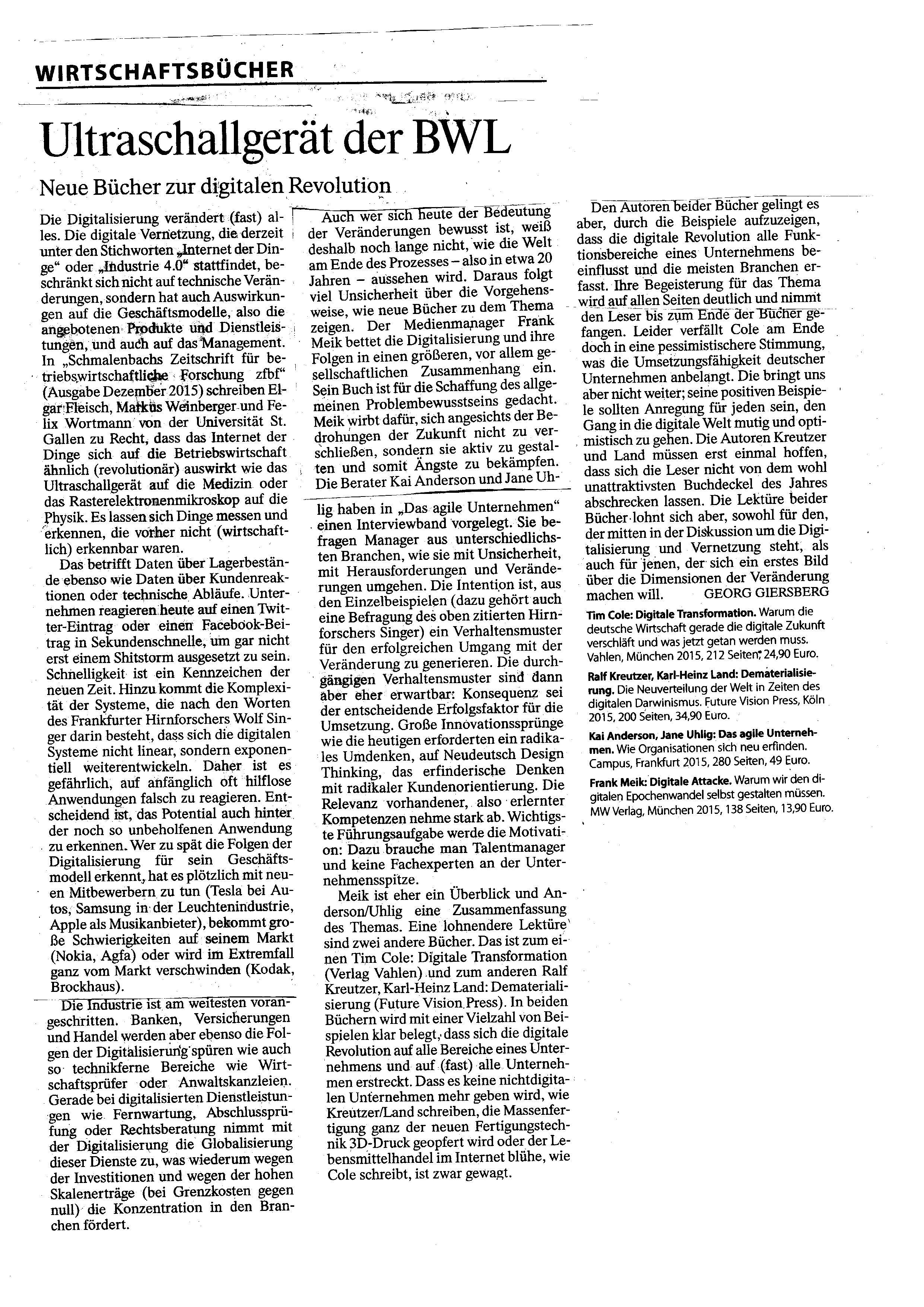
Warum tun sich manche Unternehmen so schwer, mit den Veränderungen des Digitalzeitalters zu Recht zu kommen, und warum sind andere erfolgreich. Warum ist Apple heute mehr wert als GE, Wal-Mart, GM und McDonald’s zusammen? Und vor allem: Warum gibt es kein einziges deutsches Unternehmen, dass es mit den „Big 4“ – Apple, Google, Facebook und Amazon – aufnehmen kann?  Schlafen sie in den deutschen Vorstandsetagen? Ist der deutsche Unternehmer besonders zukunftsresistent? Sind die deutschen ein Volk von Technik-Muffeln, und was bedeutet das für die Zukunft des Standorts Deutschland und den Wohlstand in diesem Land?

Wenn heute jeder Hund den Begriff „Industrie 4.0“ durchs Dorf zu bellen scheint, warum haben dann ein Drittel aller Chefs von deutschen Fertigungsunternehmen noch nie davon gehört? Warum verlangen 70 Prozent aller Führungskräfte hierzulande von ihren Mitarbeitern absolute Präsenzpflicht während der Bürostunden? Warum klammern sich die Gewerkschaften an den Acht-Stunden Tag und bekämpfen jeden Versuch, statt dessen beispielsweise Wochenarbeitskonten einzuführen, wie es die fortschreitende Digitalisierung sowie neue Arbeitsmodelle zur besseren Vereinbarkeit von Beruf und Familie eigentlich längst möglich und wünschenswert machen?

Kein Zweifel: Die Zukunft nicht nur dieses Landes wird von Digitaltechnik geprägt sein. Das Internet hat in den vergangenen 20 Jahren bereits tiefgreifende Veränderung ausgelöst, aber das ist nichts im Vergleich zu dem, was sich in den nächsten 20 Jahren tun wird. Vernetzung und intelligente Systeme werden einen riesigen Wachstumsschub auslösen, von dem aber nur diejenigen profitieren werden, die rechtzeitig einen Gang hochgeschaltet und die sich bietenden Chancen ergriffen haben.

Deshalb sei die Frage erlaubt: Sind wir Deutschen für die Digitale Transformation der Wirtschaft gerüstet? Kann es in diesem Land so etwas wie ein digitales, ein „Wirtschaftswunder 2.0“ geben? Oder haben deutsche Unternehmen und deutsche Unternehmer zu viel Angst vor der Zukunft – und sie lassen sie deshalb an sich vorbei ziehen.

Leider sieht es ganz so aus. Weiterlesen

Veröffentlicht unter Digitale Transformation | Verschlagwortet mit , , , , , , , , , , , , , | Hinterlasse einen Kommentar