
Wie ich den Blog erfand

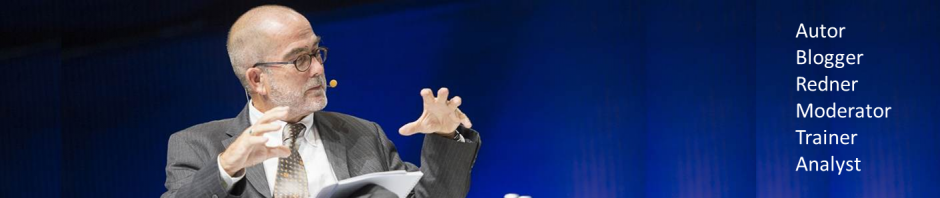
So sah anno 1995 ein Blogger aus!

Picture of the blogger as a young man

Ich bin ja ein bescheidener Mensch, wie jeder weiß, der mich kennt (nicht wahr, Michael?). Und so möchte ich in aller Bescheidenheit darauf hinweisen, dass sich heuer zum 20sten Mal der Tag jährt, an dem ich das Bloggen erfand. So weit ich weiß, jedenfalls. Und das kam so.

Ich war bis 1994 bei der Motor Presse Stuttgart als Chef der so genannten Redaktionsgruppe Multimedia für ein paar Zeitschriften (video, videoaktiv, connect) zuständig, aber auch für die BTX-Aktivitäten des Verlags. Das war der leichteste Teil meines Jobs, denn der Verlag hatte außer ein paar etwas holprige Pixelgrafiken noch nicht sehr viel zu bieten im Cyberspace. Für die jüngeren unter den Lesern sei zur Erklärung gesagt, dass BTX der Vorläufer des World Wide Web war, den die Deutsche Telekom zwischen 1983 und 2001 betrieb. Wikipedia nennt es einen „interaktiver Onlinedienst“, der „Telefon und Fernsehschirm zu einem Kommunikationsmittel“ kombinierte.

BTX war ungefähr so aufregend wie eingeschlafene Füße, aber hey, wir hatten ja nichts anderes, und es war immerhin ein Anfang. Aber dann kamen so zirka 1993 die ersten Web-Server auf, und die Online-Welt wurde plötzlich bunt und aufregend! Allerdings wusste immer noch keiner so recht, was man damit alles machen kann. Zum Beispiel gab es eine ziemlich lautstarke Fraktion unter den frühen Web-Usern, vor allem im universitären Umfeld, die strikt gegen eine „Kommerzialisierung des World Wide Web“ waren. Internet und Profitstreben passten für diese Leute nicht zusammen. Stattdessen sollte man Sachen verschenken, also zum großen gemeinsamen Ganzen beitragen, ohne dafür gleich Geld zu verlangen.

Ich gebe zu, dass mich diese eher altruistische Einstellung anfangs ziemlich beeindruckt hat. Und so überlegte ich, was ich denn so zu bieten hätte. Auch nach meinem Weggang bei der Motor Presse 1994 schrieb ich in jeder Ausgabe von connect, unserer neuen Zeitschrift zum Thema Telekommunikation, noch eine monatliche Kolumne, die ich „Mein Alltag im D-Netz“ nannte, und in der ich kleine, allzu menschliche Geschichten rund ums Mobiltelefonieren wiedergab. Und so kam ich auf die Idee, diese Anekdoten ins Web zu stellen.

Nur wie? Zum Glück kannte ich damals schon unseren Czyslansky-Bruder Sebastian von Bomhard, genannt „SvB“, der sich gerade ein Jahre zuvor mit der Firma Spacenet selbständig gemacht hatte. Wenn nicht er, wer könnte mir dann beim Start ins Web-Zeitalter helfen. SvB reservierte mir die Domain „cole.de“ und vermietete mir für kleines Geld einen Platz auf dem Spacenet-Server. Ich brachte mir selbst das kleine Einmaleins von HTML bei und bastele einen reichlich primitiven Web-Auftritt, den ich „Mein Online-Tagebuch“ nannte. Weiterlesen

Veröffentlicht unter Allgemein | Verschlagwortet mit , , , , , , , , , | Hinterlasse einen Kommentar

How we wrote our book

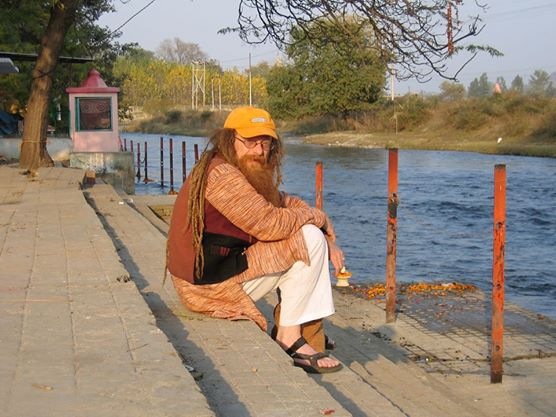
So werde ich ihn immer in Erinerung haben.

See you in the future, dude!

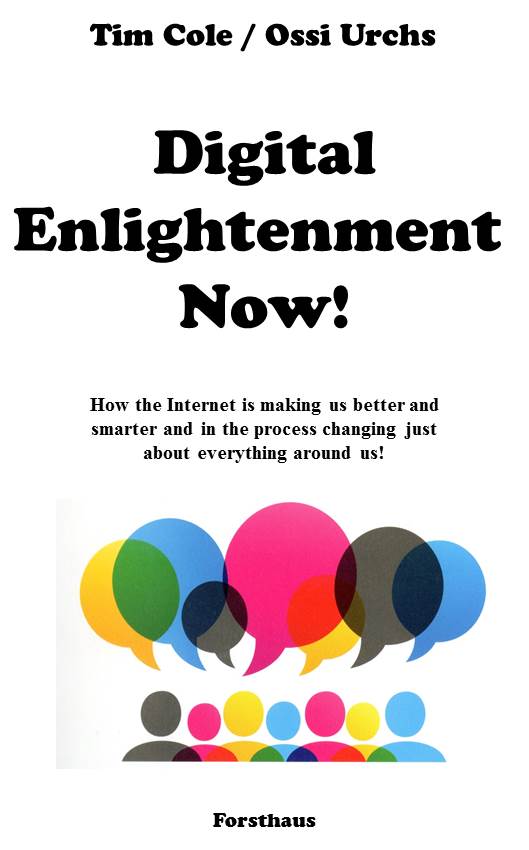
Today I finished translating the book „Digital Enlightenment“ that I wrote together with my great friend Ossi Urchs. This is the text of the afterword, and I had to update it a little in account of the fact that Ossi finally passed away after a heroic battle with cancer. We all miss him very much.

This book took more than 20 years for us to write. Ossi Urchs and I go back even further, all the way to the early 80ies when we both wrote for the German edition of Playboy which then was one of the most successful magazines in Germany (as indeed it was in the U.S. as well). We both belonged to the small, select group of “Edelfedern”; eloquent essayists that Fred Baumgaertl, the legendary editor-in-chief, surrounded himself with and whom he allowed to write about almost anything they liked.

Ossi was seriously into technology in general and virtual reality in particular, which was how he got to know Jaron Lanier so well. I had done a stint in hifi audio journalism and was getting involved in video gaming. Later, in the early 90ies, I became head of the “multimedia editorial group” at a large German publisher called Motor Presse, and I asked Ossi to write me an article about the mysterious new phenomenon people were staring to talk about called the „Internet”.

Ossi wrote a wonderful piece that focused mainly on the rock band “Grateful Dead” and their fans, most of whom were getting on in years by then, and who were wont to communicate with each other via computer through so-called “bulletin boards” that were cropping up all over cyberspace. In them, the aging hippies would exchange messages about their kids and grandkids, about concerts they had been to and where will we meet next time? And they also shared audio recordings of concerts by the band (with their express permission) through something called “FTP”.

I immediately got my own Internet connection and started using “FTP”, writing e-mails and doing something called “Gopher” which allowed you to see the folders on someone else’s computer. That was all there was back then. And then the World Wide Web came along, and neither Ossi nor I ever looked back.

In 1995, I began to publish what I then called my “Online Diary” (the term “blog” hadn’t been invented yet), and Ossi founded a company that built Websites for companies that wanted to get a foot in the door of this exciting new medium.

We both attended CeBIT every year, the giant German computer fair in Hanover, and we started to form the habit of sitting down at least once to a fine dinner at our favorite Italian restaurant, “Roma”, where Lino, the owner, would serve us “a few noodles”, and “a little wine” which made us feel like we were really sitting at Piazza Navona or looking out on Mount Vesuvius. Weiterlesen

Veröffentlicht unter Das digitale Ich, Digitale Aufklärung | Hinterlasse einen Kommentar

Vor 20 Jahren im Cole-Blog: Abhören unmöglich!

20 years of blogging.pngLaut „Spiegel“ sind Handys vor allem bei Ganoven und Kriminelle beliebt. „Mafiosi verständigen sich zunhemend per Funktelefon, denn die Polizei kann im D-Netz bislang nicht mithären“, unkten die Kollegen vom Hamburger Nachrichtenmagazin – und zitierten reihenweise Ordnungshüter, die dafür plädieren, die bislang abhörsichere GSM-Technik möglichst schnell für staatliche Lauschangriffe zu öffnen.

Die Netzbetreiber Mannesmann und Telekom werden gerügt: Angeblich würden sie sich „hinter Datenschutzbestimmungen verschanzen“. Genauer: Sie weigern sich, die entsprechenden teuren Umbauten ihrer Sendeanlagen auf Kosten der Kunden vorzunehmen. Mannesmann-Sprecherin Barbara Kögler wird mit der Forderung zitiert: „Der Staat soll zahlen.“.

Ich habe einen noch besseren Vorschlag: Laßt alles, wie es ist! Ich finde es ganz beruhigend zu wissen, daß mir niemand, aber auch niemand zuhören kann, wenn ich im D-Netz telefoniere. Wir werden im Leben schon genug beschüffelt und erfaßt.

Dieser Beitrag erschien ursprünglich im Cole-Blog am 4. Januar 1995


Besuchen Sie auch meinen Meta-Blog auf czyslansky.net, schauen Sie sich meine Videos auf YouTube an oder diskutieren Sie mit mir auf Facebook.

Veröffentlicht unter Mobilität | Hinterlasse einen Kommentar

Digital Enlightenment Terminology (2)

The future is now open for business

The future is now open for business

This is the second part of a three-part series

A second key term in our new vocabulary of Digital Enlightenment is openness, which is closely related to but not identical with transparency, and admittedly there is a risk that less enlightened minds will confuse the two. We will have to live with that.

Systems like the Open Source movement, which mandates that programmers publish their code for free, or the Open Data initiative which is based on the principle of free access to all data, have been part of online culture and economy from the very beginning.

The antonyms of openness are “closed” or “proprietary” solutions and services which are typical for corporate cultures and which are based on such traditional concepts as copyright and intellectual property. In a capitalist system, protection of property is a top economic priority, and it has therefore been transformed into a moral imperative. Immaterial property, the reasoning goes, also leads to material gain and so should enjoy similar protections. In fact, though, in the digital sphere open systems have long proving themselves both more effective and more profitable, at least in the long run.

Just a few years ago, “open” systems were considered anathema by most computer scientists and software developers. This started to change only once the Open Source movement began to demonstrate its technical and economic superiority. The reason lies in the very nature of openness: Once programmers are allowed to reuse existing code created for some other project instead of replicating the efforts of their peers, they can use their talents to create something even better. The only requirement is that they agree to hand what they have created back to the community by agreeing to its use under the terms of „Creative Commons“ agreement. That way, software can be developed much faster. In addition, the quality of the software will usually be higher because of the process of “peer review”, which is also part of the Open Source concept, performed for free by the online community as a form of self-regulation.

The business benefits of such a system are obvious. Programmers and entrepreneurs get to use the code for free, speeding up the development process, and leaving them free to concentrate their efforts (and their capital) on providing service and support for the products they have created.

Richard Stallman, a programmer and activist, was one of the first to push the open source approach as opposed to proprietary software development. Stallman became one of the founders of the Free Software Foundation, an association devoted to the concept of “freeware”: programs that are often, but not always, simply given away (donations are welcome!).

One of Stallman’s pet propositions was the “GNU Project”, which stand for for „GNU is Not Unix“. Stallman and his friends wanted to demonstrate that you can develop an entire computer operation system from scratch using freely available digital “building blocks”.

GNU was an early forerunner of Linux, the Open Source operating system for personal computers that has since been installed on at least 67 million PS around the world, according to Linuxcounter, itself another Open Source project.

Stallman was quite a radical, and his aggressive attacks on the “commercialism” practiced by his fellow software developers eventually led to him being ostracized by the community; one of the most poignant dramas in the history of computing. His place was taken by Linus Thorvald, the author of Linux, who proved to be more politic in his dealings with other software nerds, so he soon became the poster child of the Open Source movement. It is largely due to the personal charm and open-mindedness (sic!) of this Finnish-American software engineer that Open Source is not only accepted by most computer professionals today, but also has become integrally linked to the globally networked digital community.

Openness is undoubtedly one of the keys to accelerated innovation, not only in the technical sense, socially, as well. Openness not only helps us to assimilate latest technologies, but it exposes us to foreign cultures, too, turning it into an important value, and one without which Digital Enlightenment would be impossible to achieve.


Please join me on Facebook, watch my YouTube videos or listen to my latest podcasts.

Veröffentlicht unter Das digitale Ich, Digitale Aufklärung | Verschlagwortet mit , , , , , , , | Hinterlasse einen Kommentar

Digital Enlightenment Terminology (1): Transparency

The road to enlightenment

Is this the road to enlightenment?

This is the first of a three-part series

Fundamental change doesn’t just „happen”, even in times of digitalization and networking. Masses of people will need to pitch in first in order to stir up social change. In the processe, they will need to create a whole new set of categories to describe what is happening; only then will they be able to start imagining the new. This means redefining familiar terms and concepts and interpreting them in new political and philosophical ways. The “unthinkable” is only so because we lack the words to think it.

But writing a new dictionary isn’t enough; we need to fill these terms with new meaning denoting new values that are so compelling that people will invest their time, their treasure and possibly much more to achieve them.

Following the brutal murder of French journalists working for the satirical magazine “Charlie Hebdo”, people all over the world united in condemning the attack on the right of free expression. Some reminded us that this right was fought for by people with the courage to risk their very lives for an idea born from Rational Enlightenment. We will need to harness similar powers of convictions if we can ever hope to reach Digital Enlightenment.

Whenever people discuss political and philosophical ethics, they first have to agree on a common terminology. Only then can they start describing a new moral standpoint in order to elevate it to the level of a universal ethical principle. Kant had a similar problem in his day, and he went so far as to demand that the terminology used in a discussion of ethics must actually contain the elements of that ethic in order to lead to relevant results.

Ethics never stands alone; it must emerge from a discourse between conflicting systems if is is to stand the test of time. The history of philosophy is full of examples, from Aristole’s Nicomachean Ethics to Kant’s Categorical Imperative which contains his “Groundwork of the Metaphysics of Morals”, as well as the ancient Indian Bhagavad Gita or, in modern times, Jürgen Habermas and his Discourse Ethics. Without dialogue, ethics are nothing. Weiterlesen

Veröffentlicht unter Das digitale Ich, Digitale Aufklärung | Verschlagwortet mit , , , | Hinterlasse einen Kommentar

Doctrines are for dummies

Their time is over

Their time is over

As we enter the Age of Digital Enlightenment, an important question we need to ask ourselves is whether a networked society still needs monolithic, ideological constructs such as the notion of the nation state in order to function.

The same goes for many other worldviews and doctrines of salvation such as those which sprang up in the 19th and 20th centuries. Communism and capitalism, fascism and anarchism, Kodoha in Japan, Rexism in Belgium, the Acción Revolucionaria or „Gold Shirts in Mexico, as well as a host of other universal dogmas and weltanschauungen came and went, each claiming to light the only true way to true human happiness and welfare for all. Anyone who disagreed, of course,  had to be expelled or purged, either by sentence of exile or death.

Now, the era of ideology is finally coming to an end, and good riddance, too! Digital societies will be based by necessity on common-sense and consensus, not because we have all suddenly and collectively become smarter, but because digital enlightenment will make it increasingly difficult for us to believe in pat solutions to improving the human condition. Instead we will need to come up with convincing arguments and systems that actually work, at least for us and those around us.

In this future world of digitally enlightened individuals the ability to think for ourselves and in real time will be crucial. Gone are the days when a Lenin or an Henry Ford could call the pace by which society marched ahead, everyone gaily swinging their arms and singing in time. Weiterlesen

Veröffentlicht unter Das digitale Ich, Digitale Aufklärung | Verschlagwortet mit , , , , , , , , , , , , , , , , , , | Hinterlasse einen Kommentar

Digital Particularism

Kleinstaaterei

Where are we?

Openness and transparency seem to be the natural enemies of politicians around the world. In Germany, following the revelations by Edward Snowdon that the NSA had been tapping the phone of chancellor Angela Merkel, her interior minister Hans-Peter Friedrichs told a reporter for the state-owned television network ARD that “such things should be discussed behind closed doors”; where else?

Dictators and autocrats never tire in their efforts to stem the tide of openness in the countries under their thumbs. The best example is, of course, Communist China, ably assisted by their capitalist cronies at companies like Cisco, who supplied the technology behind the “Great Chinese Firewall“. This is a gigantic system of online surveillance and censorship technologies that make it exceedingly difficult (but not impossible) for Chinese citizens to surf the Web and exchange thoughts and ideas freely through Social Media. If any of these thoughts and ideas sound treasonous to the invisible censors, the thinker will probably land in jail.

But you don’t have to travel afar in order to find examples of discombobulated politicians fumbling to come to grips with ditigalization and networking. The European Data Protection Directive is a perfect example, stating as it does in article 25 that physically moving the personal data of European citizens outside the borders of the European Union is a criminal offense, especially if the “third country” the data is being transferred to does not abide by the same strict data protection standards practice in Europe. The most prominent such third country is, of course, the United States, where concepts of privacy and informational self-determination are either enitrely different, unknown or winked at officially.

Weiterlesen

Veröffentlicht unter Das digitale Ich, Digitale Aufklärung | Verschlagwortet mit , , , , , , , , , , , , , , | Hinterlasse einen Kommentar

Politics in real time

Party pooper...

Party pooper…

The purest form of democracy is one in which every citizen casts his or her vote and the majority wins. In the Internet Age, at least theoretically, everyone in the world could participate in the democratic process which could be vetted and overseen by computers programmed to detect any kind of fraud, including anybody tampering with the computers themselves.

Given that, the question is: Just how far can direct democracy go? The most radical answer of course is all the way! Digital democracy could potentially replace party politics and representative government with a participatory system giving individual citizens a direct and active role in the political decision making process.

In Europe, attempts by the short-lived “Pirate” parties have shown how difficult, not to say impossible it is to combine the concept of direct democracy with existing party structures. As long as they stayed out of the parliaments, the Pirates were an effective force driving change at many levels. Once they entered the mainstream, they imploded in the kind of petty bickering and horse-swapping deals that mark the ruling political castes. Instead of leading the way, the Pirate parties have receded into part of a vague and largely ineffectual “oppositional counterculture” that has been around for years and has, at times, been highly successful in shaping the political agenda.

The Pirate movements serves as a warning about what happens when you try to adapt truly innovative concepts to existing old and declining structures without first thinking about how these structures restrict and stifle innovation. Any attempt at introducing direct democracy into a party-driven political system is a sure recipe for failure.

Much more interesting (and more likely to succeed) are attempts such as those of the online activists going under the name of Anonymous. In their book Anonymous : Pirates informatiques ou altermondialistes numériques? (Anonymous: information pirates or digital anti-globalization?), authors Frédéric Bardeau and Nicolas Danet describe how this group of self-proclaimed “hacktivists” evolved into a kind of online offshoot of leftist activism. Through their often spectacular actions and initiatives they quickly earned themselves a worldwide reputation and could very well become a blueprint for how political decision making will be shaped in the digital future as well as for how the Internet can and will be used as a platform for political action. Weiterlesen

Veröffentlicht unter Das digitale Ich, Digitale Aufklärung | Verschlagwortet mit , , , , , , , , , , , , , , , , , , , | Hinterlasse einen Kommentar

The fear of freedom

Another upheaval

Another earth-shaking moment

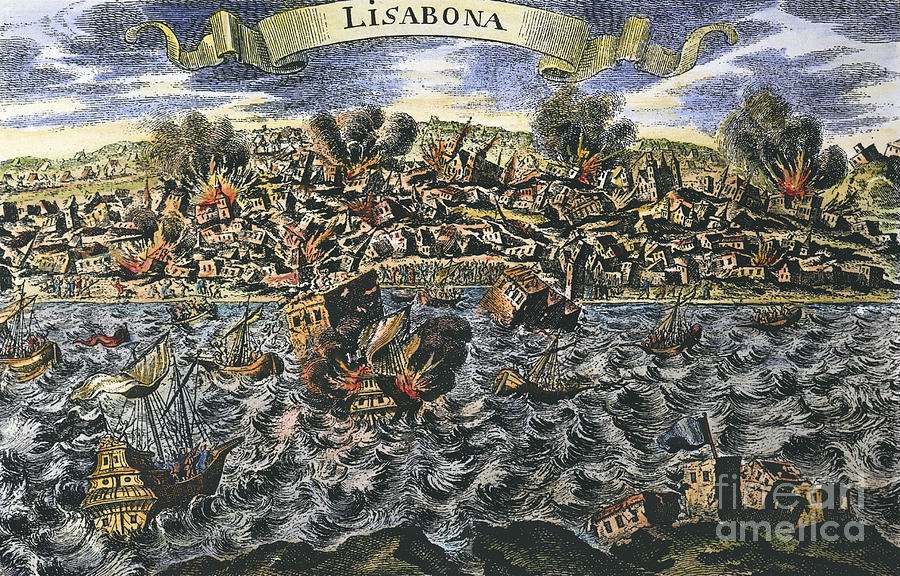
Historians of the 21st century may well date the beginning of Digital Enlightenment from the collapse of the Twin Towers in Manhattan which have had a truly earth-shaking effect, upsetting Western civilizations belief in one of our most basic human freedoms, the right to free communication. Just so, the Great Earthquake of Lisbon in 1755 shook society’s belief in divine providence, thus contributing to the subsequent era of European Enlightenment.

Just how sharply this „Earthquake of Manhattan“ has changed the United States is evident if you look at the very different reactions on both sides of the Atlantic to “NSAgate”, namely the global surveillance disclosures by the ex-NSA contractor Edward Snowdon. While Europeans were shocked, in America even liberal commentators such as Thomas Friedman (author of The World is Flat) felt compelled to state in a column for the New York Times that he, personally, would be glad to sacrifice his right to privacy if it would keep him from becoming the victim of a second 9/11. Right-wing political analysts like Ralph Manning even went so far as to demand the death penalty for Snowdons “act of treason”.

Behind these scary rantings lies a cunning logic: Since terrorists, too, use the anonymity of the Internet to disguise their devious dealings, spy agencies and law enforcement officials need to know everything that goes on in cyberspace including illegal or quasi-legal snooping on the private conversations of millions of citizens both abroad and at home. As our friend Sebastian von Bomhard put it in a blog post, governments use statistical arguments to justify invasions of privacy: “What would you prefer? Should we read all your mails or would you rather watch your family die in a terrorist attack? A, B or none of the above?” Weiterlesen

Veröffentlicht unter Das digitale Ich, Digitale Aufklärung, IT Security | Verschlagwortet mit , , , , , , | Hinterlasse einen Kommentar

Information wants to be free (but not necessarily on the house)

information-wants-to-be-free-3-638

Thanks, Eric Tachibana!

It was the mantra, the rallying cry of an entire generation of early Internet users: “Information wants to be free”. First formulated back in 1984 by Steven Levy in his book Hackers: Heroes of the Computer Revolution, the sentence was always open to different interpretations. For some, it meant “free” as in “liberty”, a freedom to say and do whatever you want (at least as long as your freedom doesn’t infringe on someone else’s). But for others, “free” had another meaning completely, namely “free of charge”.

In the early days of the World Wide Web, especially, “paid content” was a dirty word, and Internet activists argued for ages about whether “commercialism” should even be allowed online.

Artists, writers and musicians, these starry-eyed enthusiasts claimed, could and should present their collective efforts online for free. To make a living, they would use the Web as a place to advertise: musicians would give away songs for free in order to get people to attend their live concerts; writers would collect a huge following of people who would rush to bookstores (or to Amazon, which was still struggling to get started) and buy their deathless prose. And the best thing was: They wouldn’t need a publisher because they could self-publish cheaply and easily and thus cut out the middlemen who were skimming off all the profits anyway. Whoever heard of a rich author (unless your last name happened to be Grisham, King or Rowling.

Yes, those were heady days, but by now, 15 or 20 years later, we have all sort of calmed down and realized that money makes the online world go round, too. Weiterlesen

Veröffentlicht unter Das digitale Ich, Digitale Aufklärung | Verschlagwortet mit , , , , , | Hinterlasse einen Kommentar