It CAN Happen Here!

In fact, it already is happening. As far back as February 2019, The American Conservative, a maverick Republican-leaning publication founded by Pat Buchanan, warned about the usurpation of power by Donald Trump. His declaration of a national emergency to build a wall on the Mexican border that Congress had steadfastly refused to fund, the authors said, was one of the worst executive power abuses in U.S. history, if not the worst, because it was employed to usurp the power of the purse—the most important congressional check on executive overreach.

So, we know that Trump will not shrink from trashing the Constitution to attain whatever political goal he happens to pursue at any given moment. But would he actually go so far as to stage a coup if, as seems increasingly likely, he is voted out of office this fall? New York Times columnist Roger Cohen seems to think so, when he asks his readers the question, “Will he concede if beaten by Joe Biden in November?” Or put another way, can a liar accept a truth incompatible with his devouring ego? Cohen believes that the need to pose these questions reflects the depth of our national nightmare.

Seen in this light, Trump’s baseless allegations of mail voter fraud that earned him the first-ever fake news alerts from Twitter against a sitting head of state assume a more sinister aspect. Maybe this is not just a spoiled kid throwing a temper tantrum against grownups slapping his wrists for his constant lying. Maybe Trump is in fact already preparing his ground for E-Day +1?

What would happen, for instance, if he were to declare another national state of emergency a day after the election because he has “compelling evidence” that the voting was massively flawed because of mail ballot fraud? Whose job would it be to stop him? Or even to force him to actually produce the evidence he claims to have.

Obviously, Congress would need to step in, but given the unwillingness of leading Republicans to stand up to their sad caricature of a President, does anyone really believe they would? Weiterlesen →

Veröffentlicht unter An American in Austria, History | Verschlagwortet mit , , , , , , , , , , | Hinterlasse einen Kommentar

Der Amerikanische Traum wird zum Albtraum

Auf Quora fragt jemand: „Wieso gibt es in den USA so viel Polizeigewalt gegen Afroamerikaner?“ Hier ist meine Antwort.

Wie andere hier schon gesagt haben gibt es vielschichtige Gründe. Sicher ist tiefsitzender Rassismus einer davon, aber eben nicht nur. Amerika ist heute insgesamt viel polarisierter, gespaltener und unsicherer als früher. Es hat nicht geholfen, dass sich Amerika einen Präsidenten gewählt hat, der das gereizte Klima ständig anheizt. Und ganz sicher spielt die ständige Aufrüstung der örtlichen Polizeibehörden eine Rolle, die sich in den letzten Jahren teilweise mit ausrangiertem Kriegsgerät inklusive Panzerfahrzeuge bis an die Zähne bewaffnet haben.

Das Verhältnis zwischen Polizei und Bürger war in Amerika grundsätzlich immer ein feindseliges: keine Spur von „Freund und Helfer“, sondern eher ein „wir gegen die“. Die Medien tragen dazu das Ihre bei, indem sie Polizisten oft als brutale Dumpfbacken darstellen, die immer nur Jagd auf unschuldige Menschen machen. Schaut Euch nur nochmal den Film „Convoy“ von Sam Peckinpah aus dem Jahr 1978 an.

Ich denke, wir müssen die Frage eher im Zusammenhang mit dem politischen, kulurellen, moralischen und gesellschaftlichen Niedergang Amerikas sehen, der sich gerade noch beschleunigt. Der amerikanische Traum ist ausgeträumt, das „amerikanische Zeitalter“ geht zu Ende, und ich zumindest habe Angst vor dem, was danach kommen wird. Aber andererseits: Ich bin 70 Jahre alt und werde das vermutlich nicht mehr miterleben müssen.

Anmerkung 1: Ich bin in Amerika geboren und aufgewachsen, war lange Zeit darauf auch sehr stolz. Inzwischen bin ich aber froh, dass ich in Österreich leben darf und habe nicht vor, noch einmal in meine alte Heimat zu reisen. Das ist nicht mehr mein Amerika!

Anmerkung 2: Wenn Ihr glaubt, dass es in Amerika jetzt chaotisch zugeht – wartet ab bis November, wenn Trump (was leider zu befürchten ist, wie die New York Times heute unkt) abgewählt wird, aber sich weigert, das Weiße Haus zu verlassen und womöglich den Notstand ausruft. Einen Trump-Putsch werden seine Anhänger als Aufruf zum Aufstand verstehen und zu den – reichlich vorhandenen – Waffen greifen gegen Linke, Fremde, Schwule und Andersfarbige.

Veröffentlicht unter An American in Germany, Rassismus | Verschlagwortet mit , , , , | Hinterlasse einen Kommentar

Ein Besuch im Bauch von Frankreich

Hier ißt Gott in Frankreich!

Seit Corona hatte ich viel Zeit, Fragen auf Quora zu beantworten, aber diese hat mich wirklich aufgemuntert! „Welches Restaurant in Lyon ist berühmt für seine lokale Küche?“, fragte eine Dame namens Roskana Parvin Yasmin – und schickte mich auf eine wunderbare Reise in meine absolute kulinarische Lieblingsstadt.

„Das Problem mit Ihrer Frage“, schrieb ich ihr, „ist, dass es in Lyon zwei lokale Küchen und Dutzende, wenn nicht Hunderte von Restaurants zur Auswahl gibt“.

Zum einen ist Lyon – und nicht Paris – der Geburtsort dessen, was nicht nur in Frankreich als die veritable französische haute cuisine, oder Grand Cuisine, berühmt ist. Dafür gibt es mehrere Gründe.

Einer davon ist, dass Lyon näher an Italien liegt als Paris, das vor der Französischen Revolution als das Land mit der raffiniertesten Küche in Europa galt. Weiterlesen →

Veröffentlicht unter Allgemein, Essen & Trinken | Verschlagwortet mit , , , , , , , , , , , , , , , | Hinterlasse einen Kommentar

Lyon, mon amour!

Heaven must look like this!

Since Corona, I have had lots of time to answer questions on Quora, but this one really perked me up! “What restaurant in Lyon is famous for its local cuisine?”, a lady called Roskana Parvin Yasmin asked – and sent me off on a wonderful trip down memory lane to my favorite food city in the world.

“The problem with your question”, I told her, “is that there are two local cuisines and dozens, if not hundreds of restaurants to choose from.” Weiterlesen →

Veröffentlicht unter Allgemein, Essen & Trinken, Food | Verschlagwortet mit , , , , , , , , , | Hinterlasse einen Kommentar

Warum die Event-Branche noch lange nicht am Ende ist!

Das waren noch Zeiten!

Eine Branche, über die man in Zeiten wie diesen leider seltener spricht, sind die Eventveranstalter und Referentenagenturen. Bis Ende des Jahres 2019 machten sie ein blühendes Geschäft – und ich weiß das so genau, weil sie mich im vergangenen Jahr mehr als 90 Mal für eine Keynote oder einen Impulsvortrag irgendwo in Europa gebucht haben, aber seit Anfang 2020 ist das vorbei. Das sind Hunderte von meist kleineren Unternehmen mit Tausenden von Mitabreitern, denen über Nacht die Geschäftsgrundlage weggebrochen sind. Ganz zu schweigen von den Referenten selber, die oft kein Gehalt von einem großen Mutterkonzern bezogen haben und die deshalb ins Nichts blicken. Andere haben wie sich wie ich ein halbwegs lukratives zweites Standbein zugelegt oder sind einfach in Rente gegangen.

Inzwischen ist Licht am Ende des Tunnels zu sehen. Ich habe gerade die ersten Anfragen für die Herbstsaison bekommen, und zwei Veranstalter, die mich schon vor dem Ausbruch von CoVdi-109 gebucht hatten, haben inzwischen signalisiert, dass die für Spätherbst geplanten Veranstaltungen voraussichtlich durchgezogen werden.

Trotzdem haben wir alle gerade viel Zeit zum Nachdenken, und ich habe sie teilweise dazu genutzt, meinen Kollegen in den Dutzenden von Redneragenturen, die mich in der Vergangenheit unterstützt und „verkauft“ haben, etwas Mut zuzusprechen und mit ihnen meine Meinung über die Zukunftsaussuchten unserer Branche zu teilen. Das habe ich in Form einer längeren E-Mail getan, die ich hier ungekürzt wiedergeben möchte:

Liebe Agenturkollegen,

Wir stehen alle vor einem großen Scherbenhaufen. Das Geschäftsmodell „Events“ und „Speaker“ ist über Nacht kollabiert. Viele von uns sitzen, wie ich auch, daheim und verbringen unsere Tage auf Facebook oder in Videokonferenzen. Ich selbst habe das Glück, als Chefredakteur von Smart Industry – the IoT Business Magazine noch ein Einkommen zu haben, das mich über Wasser hält. Andere haben nicht einmal das.

Aber es muss uns auch klar sein, dass Corona wieder weggeht. Ob das allerdings die Rückkehr bedeutet zu „Business As Usual“ bezweifele ich. Weiterlesen →

Veröffentlicht unter Allgemein | Verschlagwortet mit , , , , , , , , | Hinterlasse einen Kommentar

Why is business intelligence important for an organization?

This is what a real computer looked like back in the earlies!

The term Business Intelligence was first used by Hans Peter Luhn, a pioneer of computer science. Luhn was born in 1896 and had been working for IBM since 1947. In 1958, he wrote an article entitled A Business Intelligence System which described methods for gaining and disseminating knowledge for and about business processes through information technology.

As a reminder, the largest computer at the time, UNIVAC I, consisted of 5,200 tubes and weighed 14 tons!

Luhns essay attracted a lot of attention because it opened up a new dimension in the computer world. Instead of merely solving admittedly very complex arithmetical problems, computers were henceforth to help people and especially managers to make more intelligent decisions by providing relevant information and defining so-called „action points“. These could be individuals, groups or an entire organization.

In 1989, Howard Dresner, an analyst with the Gartner Group, made Business Intelligence – BI for short – a key term in corporate management. Like other catchwords that emerged around this time, such as data warehousing, knowledge management and enterprise content management, BI is taught at universities and revered like a holy grail in executive offices. It is the basis for almost all processes, for the use of resources, for operative decisions and for monitoring.

In the beginning, BI was a backward-looking activity: it was about using historical data to describe the state of the company (descriptive analysis). Only later, with the advent of data mining, could BI be used to peer into the future. So-called predictive analysis allow the comparison of current and historical data in order to identify opportunities and risks for the company. Weiterlesen →

Veröffentlicht unter artificial intelligence, Business Intelligence | Verschlagwortet mit , , , , , , , , , , , , , , | Hinterlasse einen Kommentar

What are the origins of port wine?

Strabo , the great geographer of ancient Greece, wrote that inhabitants of the north west of the Iberian Peninsula were already drinking wine two thousand years before the birth of Christ. By the 10th century BCE, the Phoenicians introduced new grape varieties and winemaking techniques to the area. By the time the Romans arrived in southern Portugal the growing of vines and wine making were already part of the culture of Alentejo. In fact, they named the province Lusitania after Lusus the son of the wine god Bacchus. When the Kingdom of Portugal was founded in 1143, wine become an important export and a vital source of tax revenue for the royal house.

In 1386 the Treaty of Windsor had established a close political, military and commercial alliance between England and Portugal. and many English merchants settled in Portugal. By the second half of the 15th century a significant amount of Portuguese wine was being exported to England, often in exchange for salt cod known in Portuguese as bacalhau.

In medieval times, the centre of the wine business was not Oporto, as it later became, but the northern coastal town of Viana do Castelo  whose situation on the broad estuary of the Lima River made it a reliable natural harbour. The wine they exported was mostly so-called ‘red Portugal’, the light, acidic wine produced nearby in the Minho region. However, most wines that were being drunk in England at the time came from France and especially from southwestern France, which belonged to England under the Plantagenets (1154 to 1485) after the marriage between Henry II („Henry Curtmantle”) and Eleanor, Duchess of Aquitaine. Weiterlesen →

Veröffentlicht unter Allgemein | Verschlagwortet mit , , , , , | Hinterlasse einen Kommentar

The Stooge Who Would be Emperor

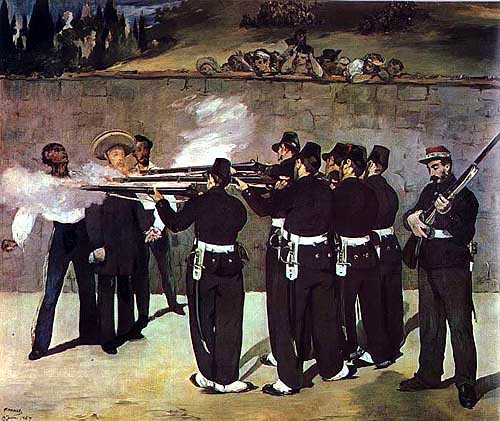
Édouard Manet, “The Execution of Emperor Maximilian” (1869)

There appears to be some confusion around the events in Mexico between 1862 and 1867, when Maximilian of Habsburg was proclaimed emperor and subsquently shot by firing squad. On Quora, a number of people have asked questions like „How long did the French occupy Mexico“ or similar ones. As an amateur history buff, as well as a resident in the country of Maximilian’s birth, I felt I needed to set the record straight, so here’s what I wrote.

Technically, the French never really “occupied” Mexico. They did try to intervene, however. French Emperor Napoleon III wanted to turn Mexico into a satellite state dependent on France in order to get his hands on Mexico’s cheap raw materials and force the country to buy French goods.

In 1861 he had already briefly sent in troops because Mexico under its Republican president Benito Juárez had expelled both the Spanish envoy and the papal legate from the country. Faced with bancrupty and the growing power of the conservatives, Juárez suspended payments on the 82 million US dollar loans from France, Great Britain and Spain. In 1862, the three European powers retaliated by sending troops to the port of Veracruz to lend weight to their demands. When Juárez conceded, the British and Spanish withdrew, but the French stayed.

Weiterlesen →

Veröffentlicht unter An American in Austria, History | Verschlagwortet mit , , , , , , , | Hinterlasse einen Kommentar

The Terrible Truth About the “Best Healthcare System in the World”

Some of my American friends have asked me to translate a post I published here a few days ago about the aweful state of healthcare in America, so here it goes:


I am often asked by Germans or Austrians why so many people in America die of Covid-19, even though they supposedly have the best health care system in the world. Most of them are surprised when I tell them that the United States, on the contrary, has one of the worst systems. The most expensive, yes. The most modern hospitals in the world, yes. But these lighthouse clinics are prohibitively expensive for 99% of Americans.

Figure 1: Bang for your bucks: Americans pay more for their health, but get less than all other developed countries.

Over the last three or so decades, the American health care system has gone downhill rapidly. Today, the health status of the US population is worse than in all other developed countries. Firstly, after several decades of improvement, life expectancy has worsened in recent years for some groups of the population, a situation exacerbated by the opioid crisis and the obesity pandemic. Secondly, with the ageing of the baby-boomers, more people in the United States – as all over the world – are living with age-related disabilities and chronic diseases, putting pressure on health systems. In fact, the American health care system is far behind in the price-to-performance ratio of all developed countries!

A pop-up dental clinic in Wise County, Virginia

Timely and accessible health care could alleviate many of these challenges, but the US health care system is failing because it is not able to reliably provide the necessary services to all those who should benefit from them. Poor access to primary care in particular has led to inadequate prevention and treatment of chronic diseases. Delayed diagnoses, incomplete adherence to treatment, wasteful overuse of drugs and technology, and problems of coordination and safety in healthcare are the norm today. Poor people often travel hundreds of miles to visit so-called „pop-up clinics“ in remote corners of America such as the Appalachian Mountains, where dentists provide basic dental care free of charge. Weiterlesen →

Veröffentlicht unter Allgemein, Gesundheit, healthcare, US-Gesundheitssystem | Verschlagwortet mit , , , , , , , | Hinterlasse einen Kommentar

Die schreckliche Wahrheit über das angeblich „beste Gesundheitssystem der Welt“

Ich werde oft gefragt von Deutschen oder Österreichern, warum so viele Leute in Amerika gerade an Covid-19 sterben, obwohl sie doch angeblich das beste Gesundheitssystem der Welt besitzen. Die meisten von ihnen sind überrascht, wenn ich ihnen sage, dass die Vereinigten Staaten im Gegenteil eines der schlechtesten Systeme hat. Das teuerste, ja. Die modernsten Krankenhäuser der Welt, ja. Aber diese Leuchtturm-Kliniken sind für 99% der Amerikaner unerschwinglich.

Bild 1: Bang for your bucks: Amerikaner zahlen mehr für ihre Gesundheit, bekommen aber weniger als alle anderen entwickelten Länder.

In den letzten drei Jahrzehnten ist das amerikanische Gesundheitssystem rapide den Bach runtergegangen. Heute ist der Gesundheitszustand der US-Bevölkerung schlechter als in allen anderen entwickelten Ländern. Erstens hat sich die Lebenserwartung, nachdem sie sich mehrere Jahrzehnte lang verbessert hatte, in den letzten Jahren für einige Bevölkerungsgruppen verschlechtert, was durch die Opioidkrise und die ernährungsbedingte Fettsuchtwelle noch verschärft wurde. Zweitens kommt hinzu, dass mit der Alterung der Babyboom-Bevölkerung mehr Menschen in den USA – und überall auf der Welt – mit altersbedingten Behinderungen und chronischen Krankheiten leben, was die Gesundheitssysteme unter Druck setzt. Tatsächlich liegt ds amerikanische Gesundsheitssystem, was das Preis-Liestungs-Verhältnis angeht, unter allen entwickelten Ländern weit abgeschlagen an letzter Stelle!

Eine Pop-up Dentalklinik in Wise County, Virginia

Eine rechtzeitige und zugängliche Gesundheitsversorgung könnte viele dieser Herausforderungen mildern, doch das US-Gesundheitssystem versagt, da es nicht in der Lage ist, allen, denen sie nutzen sollte, die erforderlichen Leistungen zuverlässig zu erbringen. Insbesondere der schlechte Zugang zur Primärversorgung hat zu unzureichender Prävention und Behandlung chronischer Krankheiten geführt. Verzögerten Diagnosen, unvollständiger Therapietreue, verschwenderischer Überbeanspruchung von Medikamenten und Technologien sowie Probleme mit der Koordination und Sicherheit im Gesundheitswesen sind heute die Norm. Arme Leute reisen oft Hunderte von Meilen, um so genannte „Pop-up Clinics“ in entlegenen Winkeln Amerikas wie den Appalachen zu besuchen, wo Zahnärzte freillig und kostenlos eine elementare Dentalversorgung anbieten. Weiterlesen →

Veröffentlicht unter An American in Austria, An American in Germany, Gesundheit | Verschlagwortet mit , , , , , , , | Hinterlasse einen Kommentar